Beyond
the Argument
You have a dispute. You've tried to resolve it.
Maybe you've tried therapy, lawyers, hours of research. And you're still stuck. That's because the fight you're having usually isn't the real one. Steven Corn spent thirty years finding what's underneath conflict, first in music industry deals, then in formal mediation. In Beyond the Argument, he shows you how to find it too, so you can stop arguing and start solving.
Paperback, ISBN 979-8-234-22052-3
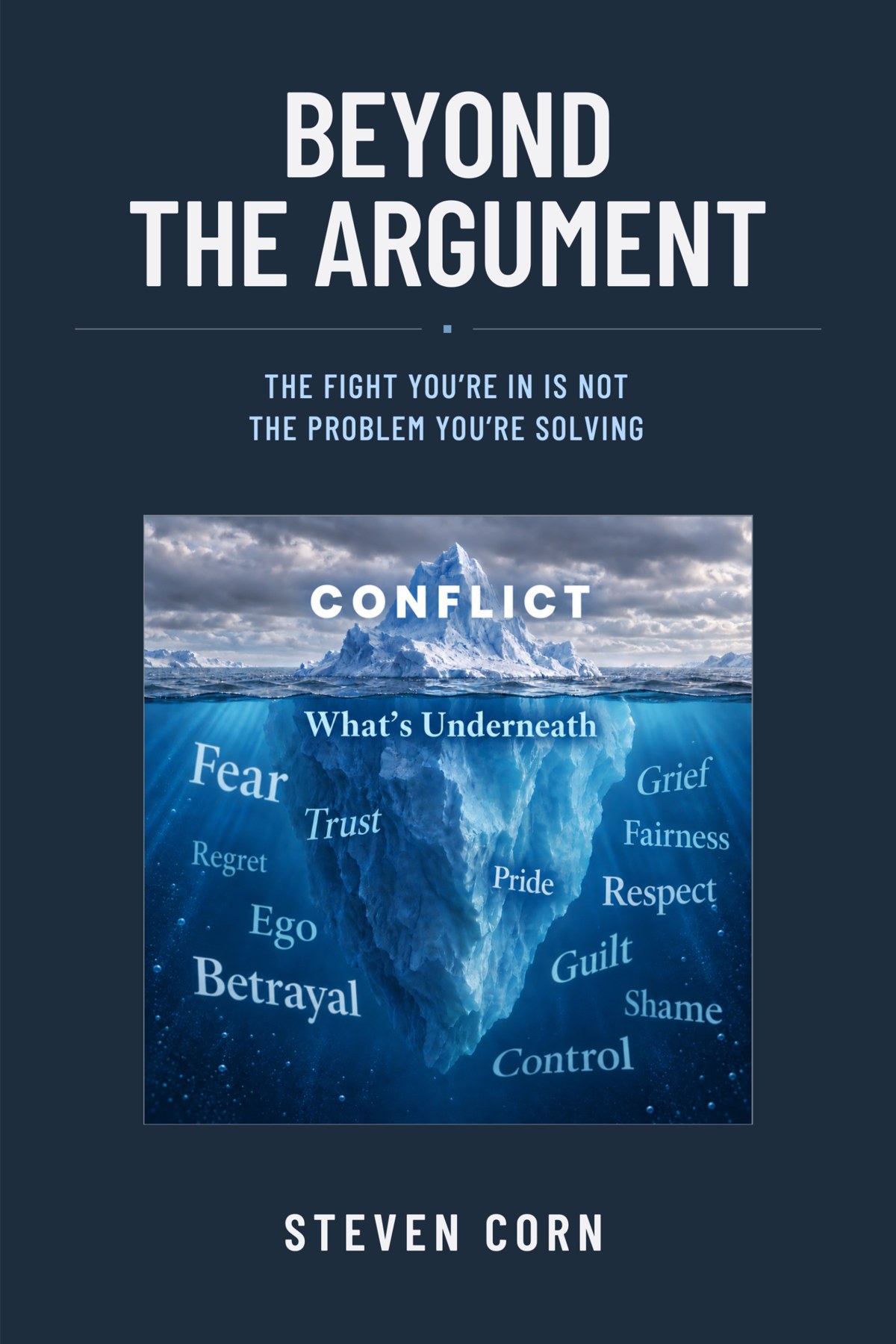
What people ask for is usually not what they need
What shows above the waterline, the money, the schedule, the house, is rarely the actual conflict. The real reasons sit underneath: feeling wronged, unheard, or unsure. Before we talk about numbers or logistics, I ask a simple question: why do you want this? That is usually where the real agreement starts.
This is also why the couple who fought about money for two years signs a property settlement and then immediately starts fighting about the custody schedule. The money was never the dispute. The settlement solved the money problem with technical precision and left the actual dispute untouched, so the same engine that powered the original conflict is still running. It will find new material.
Beyond the Argument is a field guide to the floors below the argument. It gives you a way to locate which layer you are actually stuck on, a structured method for getting there, and a test for whether the agreement you reach will survive contact with real life. The case material runs through divorce and family, business partnerships and the workplace, the music industry, and the everyday disputes with neighbors and friends that never see a lawyer.
You do not need to sue someone to get your desired result. You need to find out what the fight is really about.
What Beyond the Argument Gives You
The Dispute Stack
Every conflict has three levels: the position someone states out loud, the interest sitting underneath it, and the unspoken need underneath that. Most arguments are fought entirely on the top level. That is why they do not end.
The Five Whys
A root cause analysis method borrowed from the factory floor and adapted for emotional conflicts. A structured sequence that moves a party from what they are demanding to what they actually need, and shows you which layer you are stuck on.
What Anger Is Actually Saying
Anger as a mask for fear and grief. Anger as a demand for respect. Control disguised as control. Why reacting to anger instead of reading it keeps the dispute alive.
The Story You Are Telling Yourself
How a feeling becomes a narrative, and a narrative becomes a position you cannot back away from. Finding what the story is protecting, and asking whether it is actually doing that job.
Reframing Without Manipulation
The four reframe directions, and the line between reframing and gaslighting. How to reframe your own internal narrative before the conversation even begins.
The Agreement That Holds
Why splitting the difference so rarely lasts. The three properties of a durable agreement, and what to do when one party will not commit.
Plus extended case material on the arenas where these disputes actually live: family and divorce, business and the workplace, the music industry, and the argument with a neighbor or a friend that keeps coming back.
Beyond the Argument does something remarkably useful: it helps us see that the conflict in front of us is often not the conflict that actually needs to be resolved. Drawing on decades of experience navigating difficult conversations, Steven Corn offers an accessible, practical framework for getting beneath positions and arguments to the needs that are really driving the dispute. This is a thoughtful and highly usable book for anyone who wants to understand conflict differently and navigate it better.
American Bar Association Section of Dispute Resolution

- Maryland Program for Mediator Excellence
- Circuit Court of Maryland
- DC Superior Court
- District Court of Maryland, Howard County
- Conflict Resolution Center of Montgomery County
- ABA Dispute Resolution Section
- Southern California Mediators Association
- Beverly Hills Bar Association
- Patient Advocacy Certification Board
I didn't set out to become a mediator. I noticed I'd already been doing it for thirty years.
Credentialed mediator serving Montgomery County and the greater DC Metro area, approved by both the Maryland Circuit Court and District Court systems.
Before mediation, I spent three decades in the music industry, structuring deals and resolving disputes between parties with competing interests. I co-founded a digital distribution company that was later acquired, and a record label that went on to win multiple Grammys. Along the way I noticed the same pattern showing up again and again: the disagreement people brought to the table usually wasn't the real one, and the deal only held once we found what was underneath it.
A contract dispute between two entertainment companies and a divorce between two people are not as different as they look. Both start with someone who feels wronged. Both get worse when the practical issues get argued before the emotional ones are addressed. Staying calm in the room is not a personality trait, it's a discipline, the same one that got me through thousands of high stakes negotiations. Not detachment, just enough tough situations so that yours won't rattle me.
My role isn't to take sides. It's to help everyone reach an agreement that works.
I create a little extra peace in the world by helping people resolve their disputes.
Creating a little extra peace in the world.